New Zealand Economic Operating System (NZ-EOS)
A System for National Economic Growth and AI-Enabled Competitiveness
Framework by Chris Blair
Version 1.0 - Living Framework
Updated periodically as new research emerges
This framework is being progressively expanded with system mappings, institutional roles, and execution pathways.
A national blueprint for building an intelligence-native export economy
The New Zealand Economic Operating System (NZ-EOS) is a strategic framework for positioning New Zealand as a high-value, intelligence-driven export economy.
It brings together economic engines, innovation systems, and national capabilities required to double exports and compete in a world shaped by AI, energy, and compute.
Rather than focusing on individual initiatives, NZ-EOS describes the system New Zealand must build - spanning capital, energy, research, data, workforce, governance, and AI-driven industries.
This framework is designed to help:
• Government leaders align national priorities
• Boards understand structural economic shifts
• Investors identify long-term opportunity areas
• Technology leaders align capability development
• Export industries prepare for AI-driven competition
• Policy makers coordinate cross-agency delivery
NZ-EOS is not a policy.
It is a systems-level map of what must exist for New Zealand to scale.
Framework Structure
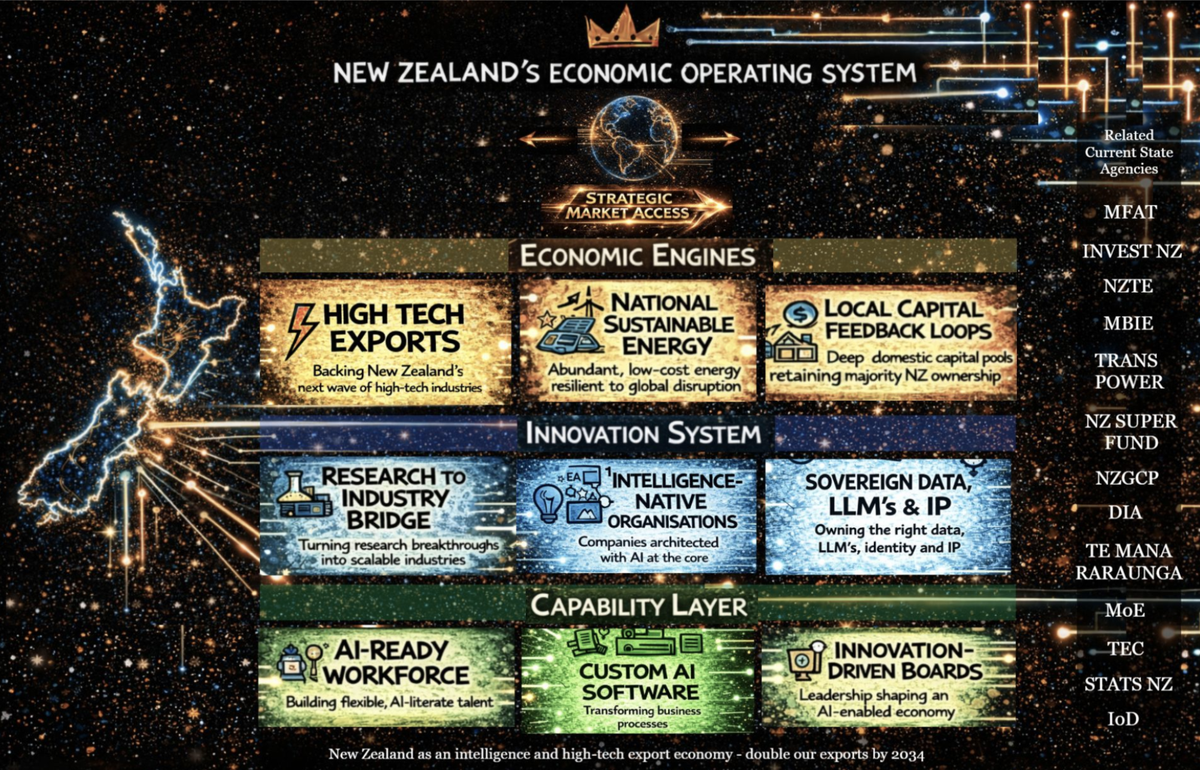
NZ-EOS is composed of three layers:
Economic Engines - what drives growth
Innovation System - how new industries emerge
Capability Layer - what enables execution
Together these form a national economic operating system.
ECONOMIC ENGINES
These are the structural drivers of long-term export growth.
1. High Tech Exports
Backing New Zealand’s next wave of high-tech industries
High-tech exports represent New Zealand’s pathway to non-commodity growth and global competitiveness. These include software, AI, aerospace, health technology, advanced manufacturing, and digital platforms.
This pillar includes:
• SaaS and vertical AI companies
• aerospace and space technology
• health and med-tech innovation
• robotics and advanced manufacturing
• digital platforms and global software
• AI-native startups
• deep tech ventures
• quantum and frontier technologies
Why this matters:
High-tech exports scale globally without the same logistics constraints as physical exports. They increase export value per employee and help New Zealand compete despite geographic distance.
2. National Sustainable Energy
Abundant, low-cost energy resilient to global disruption
Energy becomes a strategic economic advantage in an AI-driven world. Compute, datacenters, manufacturing, and logistics all depend on reliable energy.
This pillar includes:
• renewable energy expansion
• geothermal scale development
• hydro capacity optimisation
• wind and offshore wind potential
• grid modernisation and expansion
• industrial electrification
• energy storage systems
• green hydrogen and process heat
• energy for AI datacenters
• energy security for exports
Why this matters:
In an AI economy, energy availability becomes a competitiveness advantage. Countries with abundant renewable energy can host compute, scale industry, and lower export costs.
3. Local Capital Feedback Loops
Deep domestic capital pools retaining majority NZ ownership
This pillar focuses on building New Zealand-owned growth rather than exporting value offshore.
This includes:
• sovereign investment vehicles
• venture capital scale-up funding
• growth capital for NZ companies
• KiwiSaver deployment into innovation
• NZ Super strategic investment
• domestic institutional capital mobilisation
• IPO pathways for NZ tech firms
• private market liquidity
• co-investment mechanisms
Why this matters:
Without local capital, successful companies often relocate offshore. Strong domestic capital ensures New Zealand retains ownership of its future industries.
INNOVATION SYSTEM
This layer describes how New Zealand turns ideas into industries.
4. Research to Industry Bridge
Turning research breakthroughs into scalable industries
New Zealand produces strong research but often struggles to commercialise at scale. This pillar focuses on closing the gap between research and industry.
This includes:
• university commercialisation pipelines
• startup spin-out pathways
• applied research programmes
• industry research partnerships
• innovation districts and clusters
• IP commercialisation support
• translational research funding
• national research missions
• deep tech incubation
Why this matters:
Countries that convert research into companies create new industries. This bridge is essential for long-term export growth.
5. Intelligence-Native Organisations
Companies architected with AI at the core
This pillar describes organisations designed around AI, automation, and data rather than traditional structures.
This includes:
• AI-first operating models
• autonomous business processes
• decision intelligence systems
• AI embedded across workflows, decisions, and operations
• agent-driven workflows
• intelligence platforms
• digital twins and simulation
• AI-native service delivery
• automated operational systems
Why this matters:
AI-native companies operate faster, scale globally, and reduce cost structures. This becomes a structural competitive advantage.
6. Sovereign Data, LLMs & IP
Owning the right data, identity and intellectual property
Data becomes a national strategic asset in the AI era. This pillar focuses on ownership and governance.
This includes:
• national data frameworks
• sovereign AI models
• domain-specific LLMs
• identity infrastructure
• trusted data sharing
• Māori data sovereignty
• IP retention strategies
• data trusts and governance
• secure AI infrastructure
Why this matters:
Countries that control trusted data, identity, and domain intelligence capture economic value in the AI era. Without this, local industries generate the data but offshore platforms capture the value.
CAPABILITY LAYER
This layer enables execution of the system.
7. AI-Ready Workforce
Building flexible, AI-literate talent
This pillar focuses on workforce transformation for AI-driven industries.
This includes:
• AI literacy across industries
• technical AI skill development
• retraining and reskilling programmes
• education system alignment
• vocational AI pathways
• industry learning ecosystems
• AI adoption support for SMEs
• leadership capability uplift
Why this matters:
AI transforms work. Countries with AI-ready talent adapt faster and build new industries sooner.
8. Custom AI Software
Transforming business processes
This pillar focuses on building New Zealand-specific AI systems across industries.
This includes:
• vertical AI software
• industry-specific AI platforms
• automation of export sectors
• supply chain intelligence
• logistics optimisation
• agricultural AI systems
• manufacturing AI systems
• government AI platforms
• decision intelligence tools
Why this matters:
Custom AI software becomes the operating layer of the economy. This drives productivity and export competitiveness.
9. Innovation-Driven Boards
Leadership shaping an AI-enabled economy
This pillar focuses on governance transformation.
This includes:
• AI-aware board governance
• innovation strategy leadership
• long-term capital allocation
• risk vs opportunity mindset
• technology literacy at board level
• industry transformation oversight
• ecosystem collaboration
• energy, compute, and infrastructure as strategic board-level decisions
Why this matters:
Boards shape investment and strategy. In an AI-driven economy, decisions around technology, capital, and energy access become structurally linked. Innovation-driven boards accelerate national transformation and long-term competitiveness.
Strategic Market Access
NZ-EOS sits within global market access. New Zealand must:
• build trade relationships
• secure digital trade pathways
• expand services exports
• enable cross-border AI delivery
• strengthen export partnerships
• support global scaling companies
Institutional Landscape
The NZ-EOS is not a single organisation, programme or project.
It is a blueprint for how New Zealand’s economic system can be aligned to support growth, resilience, and long-term competitiveness.
The entities below represent the institutional backbone around that blueprint - spanning national direction, coordination, and delivery enablement.
They operate across three core tiers:
- Tier 1 - System Architects & Core Institutions
Set direction, allocate capital, define infrastructure, and establish national capability - Tier 2 - System Shapers & Coordinators
Influence direction through strategy, foresight, standards, and industry alignment - Tier 3 - System Enablers & Delivery Layer
Activate the system at a regional, sector, and operational level
Together, these tiers form the institutional backbone of NZ-EOS.
A further layer - the builders - sits beyond this: companies, regional coalitions, infrastructure developers, investors, and delivery partnerships that would ultimately construct and operate the system in practice.
TIER 1: System Architects & Core Institutions
Core agencies and institutions that define national direction, system settings, infrastructure, capital flows, data systems, and capability.
These entities define what the system is trying to achieve and create the conditions for it to work.
How Tier 1 Operates
These institutions operate across a small number of core system functions:
- Direction - setting national priorities and system settings
- Production - shaping what New Zealand produces and exports
- Access - enabling entry into global markets
- Capital - funding growth and infrastructure
- Coordination - aligning capability, infrastructure, and delivery
MBIE
Agency: Ministry of Business, Innovation and Employment
NZ-EOS relevance
(Direction)
Sets the national economic direction and system settings - including the explicit goal to double export value within 10 years (to 2034), linking trade, investment, and productivity.
Defines the policy environment, priorities, and growth settings that shape how the broader economic system operates and scales.
Related Sources
Going for Growth
New Zealand AI Strategy - Investing with Confidence
Digital Strategy for Aotearoa
Research, Science and Innovation Strategy
MPI
Agency: Ministry for Primary Industries
NZ-EOS relevance
(Production)
Shapes the production system that underpins New Zealand’s export economy - including the resilience, sustainability, and performance of primary industries, New Zealand’s dominant export engine.
Governs biosecurity, food systems, land use, and sector productivity - directly influencing the scale, quality, and global trust of exports, and enabling the transition toward higher-value, technology-enabled export systems.
Related Sources
MPI Strategy 2030
Biosecurity System Action Plan
Biosecurity in New Zealand (System Overview)
NZTE
Agency: New Zealand Trade and Enterprise
NZ-EOS relevance
(Execution)
Drives exporter growth and global scaling - acting as the primary delivery arm that translates national growth ambition into export revenue and globally anchored value.
Works directly with firms to expand into global markets - converting capability into export performance and turning strategy into commercial outcomes.
Mandate shift (important new context)
NZTE’s role has shifted toward a clear export-first focus, with foreign investment attraction and broader economic functions increasingly separated (e.g. Invest New Zealand).
Within NZ-EOS, this positions NZTE as the frontline execution layer - orchestrating the connection between firms, markets, and system capability to enable scalable export growth.
Related Sources
NZTE Mandate and Role in Export Growth
New Zealand Story - National Export Positioning Framework
New Zealand Trade & Export System (NZ Inc Approach)
MFAT
Agency: Ministry of Foreign Affairs and Trade
NZ-EOS relevance
(Access)
Enables global market access - securing trade agreements, diplomatic relationships, and international positioning required for New Zealand exports to compete, scale, and secure market presence.
Shapes the external conditions of the system - determining where and how New Zealand firms can enter, operate, and grow in international markets.
Related Sources
New Zealand Free Trade Agreements
Trade and Economic Diplomacy
Invest New Zealand
Agency: Invest New Zealand
NZ-EOS relevance
(Capital)
Attracts strategic capital into the system - directing foreign investment into priority sectors to support growth, infrastructure development, and global competitiveness.
Enables capital formation at scale - connecting global capital to New Zealand growth opportunities and enabling the development of high-value export sectors.
Related Sources
Invest New Zealand - Mandate and Role
Invest New Zealand - Investment Pathways
Establishment of Invest New Zealand
The Treasury
Agency: The Treasury
NZ-EOS relevance
(Measurement / System Performance)
Defines how national success is measured - establishing frameworks such as the Living Standards Framework and Wellbeing Budget that expand performance beyond GDP.
Shapes the system’s definition of value - integrating economic, social, environmental, and cultural outcomes into national decision-making.
Related Sources
Living Standards Framework (LSF)
New Zealand Budget and Wellbeing Budget Process
Wellbeing Budget 2023 - Support for Today, Building for Tomorrow
Public Service Commission (PSC)
Agency: Public Service Commission
NZ-EOS relevance
(Coordination / System Governance)
Establishes centralised oversight of government capability - shaping investment, procurement, and operating models across the public service.
Drives system-wide coordination - reducing fragmentation and enabling a more unified, scalable approach to digital, capability, and service delivery.
Operational Lead
Government Chief Digital Officer (within DIA)
Related Sources
Driving down the cost (overview)
Driving down the cost (implementation)
Department of Internal Affairs (DIA)
Agency: Department of Internal Affairs
NZ-EOS relevance
(Digital Infrastructure)
Provides core digital infrastructure - including identity systems, data exchange frameworks, and platform services that enable interoperable public services.
Underpins the functioning of a connected digital economy - supporting trust, service delivery, and system-wide integration.
DIA doesn’t just deliver digital services - it defines the identity and interoperability foundations that determine how New Zealand operates as a connected digital system.
System Linkages
Connects the core data and governance layers of the system:
- Stats NZ - provides the national data infrastructure and system visibility
- Te Mana Raraunga - defines how data is governed, trusted, and used
DIA enables these layers to operate together - providing the identity and interoperability infrastructure that allows data to be shared, accessed, and applied across the system.
Together, these layers form the foundation of a trusted, interoperable digital economy.
Related Sources
Digital Strategy for Aotearoa (National digital system direction)
Trust Framework for Digital Identity (National identity layer)
Service Modernisation Roadmap v2 (Reusable digital components and API standards)
Stats NZ
Agency: Statistics New Zealand
NZ-EOS relevance
(Data Infrastructure / Measurement)
Provides the national data infrastructure and measurement backbone - enabling evidence-based decision-making across government, industry, and research.
Supports system visibility - ensuring the ability to understand performance, track outcomes, and inform policy and investment decisions.
Related Sources
Integrated Data Infrastructure (IDI)
Transpower
Agency: Transpower New Zealand
NZ-EOS relevance
(Energy Infrastructure)
Operates the national electricity grid - providing the energy backbone required for industrial growth, electrification, and AI and data centre compute demand.
Determines the system’s capacity to scale - enabling or constraining future economic expansion through energy availability, transmission capability, and resilience.
Energy has historically been invisible in economic strategy - until it becomes a constraint.
Transpower doesn’t just operate infrastructure - it defines the energy boundary conditions of New Zealand’s participation in the global intelligence economy. In an AI-driven economy, it effectively sets the upper limit of national growth. Without sufficient, reliable, and scalable energy infrastructure, the system cannot support high-value industry, advanced manufacturing, or globally competitive compute capability.
Related Essays
The Invisible Pillar of AI (ChrisBlair.ai)
Related Sources
Net Zero Grid Pathways (National grid expansion and electrification programme)
Transmission Tomorrow (Strategic grid roadmap - PDF)
Whakamana i Te Mauri Hiko (Energy system strategy)
NZ Super Fund
Agency: New Zealand Superannuation Fund
NZ-EOS relevance
(Sovereign Capital)
Deploys long-term sovereign capital into strategic assets - supporting national wealth creation and economic resilience.
Acts as a stabilising capital layer - investing across generations to strengthen system-level capability and long-term growth.
Related Sources
Investment Strategy
NZ Growth Capital Partners (NZGCP)
Agency: New Zealand Growth Capital Partners
NZ-EOS relevance
(Venture & Growth Capital)
Provides venture and growth capital - enabling New Zealand companies to scale and compete globally.
Strengthens the domestic capital ecosystem - supporting innovation, company formation, and the development of high-growth export businesses.
Related Sources
Growth Capital Strategy
Ministry of Education (MoE)
Agency: Ministry of Education
NZ-EOS relevance
(Foundational Capability)
Shapes the foundational education system - building long-term workforce capability and national skill development.
Establishes the baseline for future talent - influencing the system’s ability to adapt, learn, and evolve over time.
Related Sources
Education System Strategy
Tertiary Education Commission (TEC)
Agency: Tertiary Education Commission
NZ-EOS relevance
(Workforce Alignment)
Aligns tertiary education and training with industry needs - supporting the development of an AI-ready and export-capable workforce.
Translates system demand into capability supply - ensuring skills, training, and education pathways meet evolving economic requirements.
Related Sources
Tertiary Education Strategy
Te Mana Raraunga
Entity: Māori Data Sovereignty Network
NZ-EOS relevance
(Trust / Sovereign Data)
Provides leadership on Māori data sovereignty - ensuring data governance frameworks reflect indigenous rights, perspectives, and long-term stewardship.
Anchors the system in trust - enabling the development of data, identity, and AI systems that are governed, ethical, and uniquely grounded in Aotearoa.
Te Mana Raraunga doesn’t just advocate for data sovereignty - it defines the governance architecture required for New Zealand to operate as a trusted node in the global intelligence economy.
Related Sources
Māori Data Sovereignty Principles (Canonical)
Te Mana Raraunga Charter (Te Tiriti grounding)
CARE Principles for Indigenous Data Governance (Global interoperability)
Institute of Directors (IoD)
Entity: Governance Membership Body
NZ-EOS relevance
(Governance Capability)
Builds governance capability at the board level - enabling organisations to lead through transformation and long-term strategic decision-making.
Shapes leadership behaviour - influencing how organisations allocate capital, manage risk, and pursue innovation.
Related Sources
IoD Governance Framework
TIER 2: System Shapers & Coordinating Bodies
Forums, think tanks, and industry bodies that influence strategy, foresight, standards, and alignment across the system.
These entities do not directly control the system - but they influence how it evolves.
BusinessNZ
Entity: National Business Advocacy Network
NZ-EOS relevance
Represents business interests and influences economic policy, labour markets, and productivity settings across the economy.
Related Sources
BusinessNZ Policy Platform
NZTech / TechNZ
Entity: Technology Industry Association
NZ-EOS relevance
Drives growth of the technology sector, shaping digital capability, innovation ecosystems, and international competitiveness.
Related Sources
NZTech Strategy
AI Forum New Zealand
Entity: Industry AI Forum
NZ-EOS relevance
Provides leadership on AI adoption, strategy, and ethics, influencing how AI capability develops across the economy.
Related Sources
AI Strategy for New Zealand
Identity New Zealand
Entity: Digital Identity Forum
NZ-EOS relevance
Leads thinking on digital identity, trust frameworks, and data exchange - foundational to a secure and interoperable digital economy.
Related Sources
Digital Identity Framework
Infrastructure Commission (Te Waihanga)
Agency: New Zealand Infrastructure Commission
NZ-EOS relevance
Provides long-term infrastructure strategy and planning across transport, energy, water, and digital systems.
Related Sources
30-Year Infrastructure Strateg
Te Puna Whakaaronui
Entity: Food and Fibre Sector Think Tank
NZ-EOS relevance
Provides foresight, strategic insights, and transformation guidance for the food and fibre sector, supporting export growth and system evolution.
Related Sources
Te Puna Whakaaronui Reports
Public Service Commission (cross-system role)
In addition to Tier 1 responsibilities, PSC also plays a coordination role across agencies - aligning delivery and capability.
Future-focused Industry & Policy Forums
Entity: Cross-sector Coordination Forums: GrowNZ, Business councils
NZ-EOS relevance
Support alignment between public and private sectors, helping translate national strategy into coordinated action and sector-level execution.
TIER 3: System Enablers & Delivery Layer
Regional bodies, industry groups, and operational institutions that activate the system in practice.
These entities are critical to the “how” of NZ-EOS - where strategy becomes implementation.
Regional Economic Development Agencies (EDAs)
Entity: Regional Development Bodie
NZ-EOS relevance
Drive regional growth initiatives, investment attraction, and sector development at a local level.
Chambers of Commerce
Entity: Regional Business Networks, such as Canterbury Chamber of Commerce, Business South, Auckland Unlimited
NZ-EOS relevance
Support businesses with capability building, networking, and export readiness.
Related Sources
Chamber Strategies
Regional Councils & Local Government
Entity: Local Authorities
NZ-EOS relevance
Enable infrastructure, land use planning, and regional investment conditions that support economic growth.
Related Sources
Long-Term Plans (LTPs)
Public Trust
Entity: Autonomous Crown Entity
NZ-EOS relevance
Provides independent supervision and governance across financial and investment structures, supporting trust and integrity in capital markets. Acts as an enabling institution within the capital and governance layer of NZ-EOS.
Related Sources
Corporate Trustee Services
Industry Clusters & Sector Groups
Entity: Sector Coordination Bodies
NZ-EOS relevance
Enable collaboration, innovation, and capability development within industries, supporting practical implementation of growth strategies.
Together, these tiers represent a connected system - not a hierarchy.
NZ-EOS does not require new institutions.
It requires alignment across the ones that already exist - connecting strategy, capital, capability, infrastructure, and execution into a coherent operating system for growth.
This blueprint defines the system.
These institutions shape it.
The builders - companies, regions, and delivery coalitions - will ultimately bring it to life.
Why NZ-EOS is helpful
NZ-EOS helps leaders:
• see the system, not just initiatives
• align policy and industry
• identify missing capabilities
• prioritise investment areas
• understand AI-era economic shifts
• coordinate cross-agency activity
• accelerate export growth
Related Frameworks
The Studio Model
The organisational operating system for building and scaling AI capability
Explore the Framework
Supporting essays explore how this system can be designed, activated, and scaled.
NZ-EOS Framework (Foundational Essay)
An executive overview of how the system fits together
The Structural Shift in New Zealand
Why recent government structural changes create a window to establish NZ-EOS
Intervention Points for AI Impact
Where leaders can act to accelerate system-level transformation
Browse related essays
These essays explore key dimensions of the system:
Building AI Advantage on Sovereign Data and Trust
New Zealand’s Missing AI Infrastructure
Scaling AI with the Dual Speed Model
Browse all essays
About the Author
Chris Blair is an AI economy strategist focused on how countries and organisations transition into intelligence-native systems. His work explores the intersection of AI, energy, infrastructure, and export-led growth.
The NZ-EOS framework is part of a broader body of work exploring how New Zealand can position itself for the AI-driven global economy.
Versioning & Framework Metadata
Framework: New Zealand Economic Operating System (NZ-EOS)
Author: Chris Blair
Version: 1.0
Status: Initial Canonical Release
Published: March 2026
Framework Type: National Economic Architecture
Geographic Focus: New Zealand
Scope: Economic + Technology + Capability System
Primary Use Case: Designing and aligning a national system for AI-enabled economic growth and global competitiveness
Update Model: Iterative Versioning
This is Version 1.0 of a living framework. Future iterations will expand system mappings, institutional roles, and execution pathways, and may refine pillars, infrastructure layers, and delivery mechanisms over time.
Citation
Blair, C. (March 2026).
New Zealand Economic Operating System (NZ-EOS). Version 1
chrisblair.ai/nzeos/